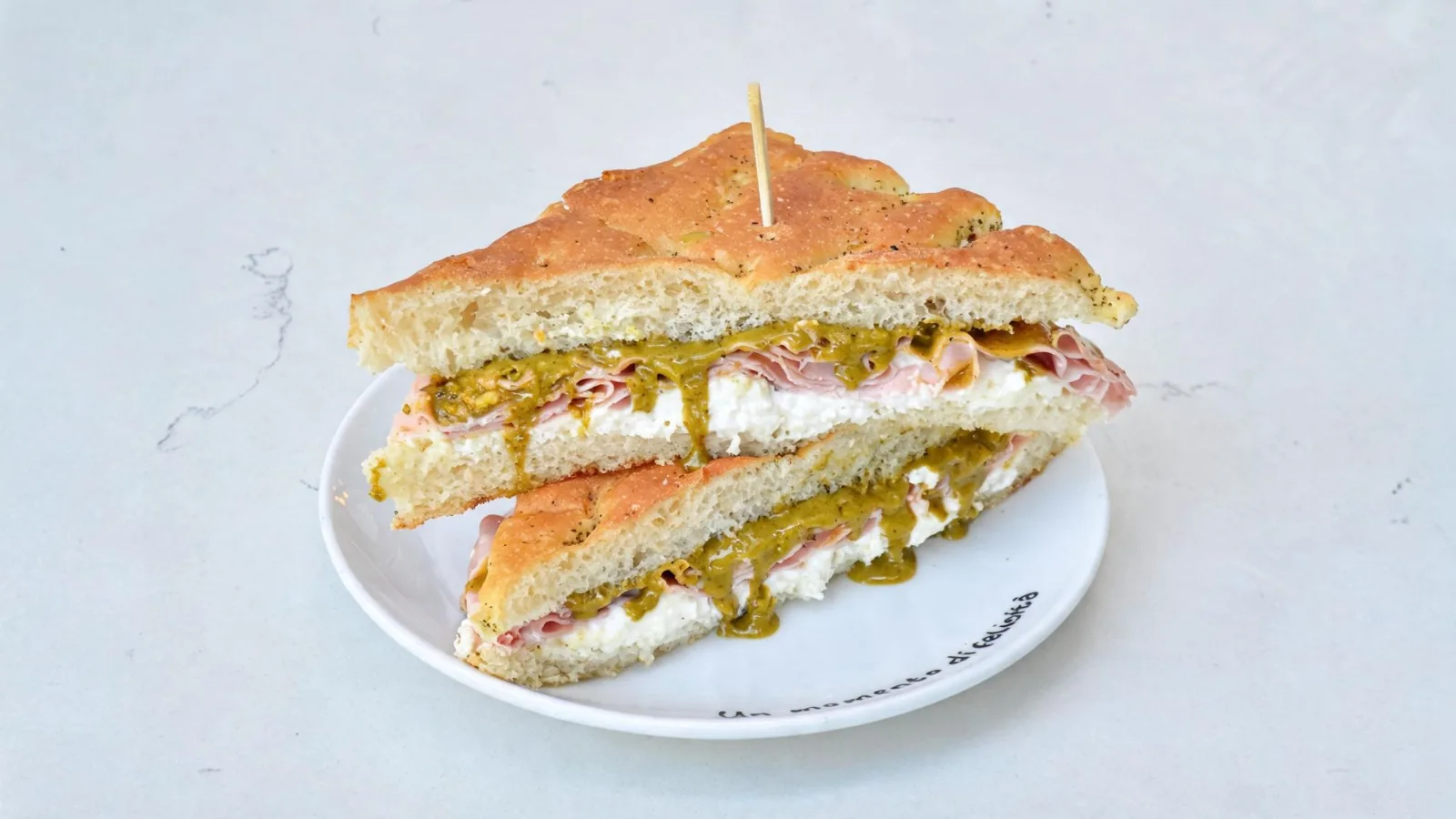
Panino is Italian for one sandwich, literally a small bread roll; panini is the plural. In the United States and Britain, panini became the singular and came to mean a sandwich pressed on a hot grill. In Italy a panino is simply bread with a filling, often only two or three ingredients, and it may or may not be toasted.
The grammar, settled in two lines
The Treccani dictionary defines panino as a small form of bread, usually round or oval, often split and filled with cured meat or cheese. The word is a diminutive of pane, bread, so a panino is, at root, a little loaf. One is a panino; two or more are panini. When Italians want to be precise about a filled one, they can say panino imbottito, a stuffed panino, though in daily speech the short word does the job.
English borrowed the plural and treated it as singular, the way it did with graffiti. So you will hear “a panini” and “paninis” in American cafés, and “a panino” from people who studied Italian. Neither will get you the wrong sandwich at our counter.
When panini started to mean pressed
In much of the English-speaking world, panini picked up a second meaning along the way: a sandwich warmed and flattened in a ridged grill press, with stripes on the bread. That is a perfectly good sandwich, but the press is not part of the Italian word. Nothing in the Italian definition requires heat, and an Italian panino can just as well be cold, on bread baked that morning.
Italy does have a pressed sandwich of its own. It is just called something else. Order un toast at an Italian bar and you get two slices of bread with ham and cheese, then toasted, usually in a press, until the cheese melts; the Treccani dictionary lists it under that English word. So the grilled ham and cheese exists in Italy, but nobody there would call it a panino.
The press also changes the priorities. Flattening a sandwich under heat favors soft bread and melting cheese, and it tends to make every sandwich taste a little alike. An Italian panino usually goes the other way and lets the bread be itself.
What makes a panino Italian
Three habits, more than any recipe.
- Bread first. The bread is chosen before the filling, and it is often the most interesting thing in the sandwich: focaccia, ciabatta, schiacciata, a soft oil roll. If you want the differences, we wrote a field guide to focaccia, ciabatta and schiacciata.
- Few ingredients. Two or three, sometimes four. Ham and cheese. Mortadella alone. Tomato, mozzarella, basil. The point is that you can taste each one.
- No sauce to hide behind. Olive oil, perhaps a spread made from one of the ingredients, rarely anything heavier. Mayonnaise and mustard exist in Italy, but they are not the default.
The panino's relatives in the glass case
Walk up to any Italian bar counter at lunchtime and the panino is rarely alone. Next to it sits the tramezzino, which Treccani describes as a word proposed as the Italian answer to the English sandwich: two or three slices of soft sandwich loaf, pane in cassetta, filled with tuna, egg, ham, artichokes or lettuce. Then there is the toast, already mentioned, warm and flat.
The difference matters to Italians even if it looks small. A tramezzino is about the filling and the soft white bread; a toast is about melted cheese; a panino is about the bread you chose. Three sandwiches, three words, and none of them is the American panini.
How a panino gets eaten at lunch
For many Italians the panino is a working-day lunch, and it is eaten quickly. A typical scene is a bar counter at one o'clock: a sandwich from the glass case, warmed briefly if you ask, a glass of water or a soft drink, an espresso to finish, and back to work. In Milan in the 1970s and 1980s whole sandwich bars, the paninoteche, became fashionable around this habit.
A panino does not even have to be savory. Treccani notes that the roll can be made from a sweet dough, and in Sicily a split brioche filled with gelato is eaten exactly like a sandwich. Naples, for its part, has the panuozzo, made from pizza dough, and its own stuffed rolls baked with salami and cheese inside.
It is food you can hold in one hand, which is why it fits standing up. The panino is to lunch what the cornetto is to breakfast.
Our paninis, and the bread under each one
Our own menu says paninis, because in Miami that is the word people use. The sandwiches themselves follow the Italian rules.
The Pistacchione is toasted focaccia with mortadella, burrata, Bronte pistachio pesto and pistachio crumble; the name means “the big pistachio”. Il Classico keeps it simpler, on pane & olio with prosciutto cotto, fresh fior di latte mozzarella and dry-aged cherry tomatoes. The schiacciata is a sesame-topped flatbread filled your way, with cotto, caprese or tuna.
The same toasted focaccia carries the Parma al Verde, with Prosciutto di Parma, rucola and pistachio pesto, and a slipper of ciabatta holds the porchetta in Il Rustico. Il Tricolore even goes inside a croissant, which would make a Florentine sandwich maker raise an eyebrow, and which works because the ham and cheese are so mild.
Different breads, few fillings, nothing pressed flat. If you want to eat one the Italian way, order at the counter, take an espresso after it, and give the whole thing fifteen minutes.
On our counter: Parma al Verde. Every dish, one by one: our dishes.