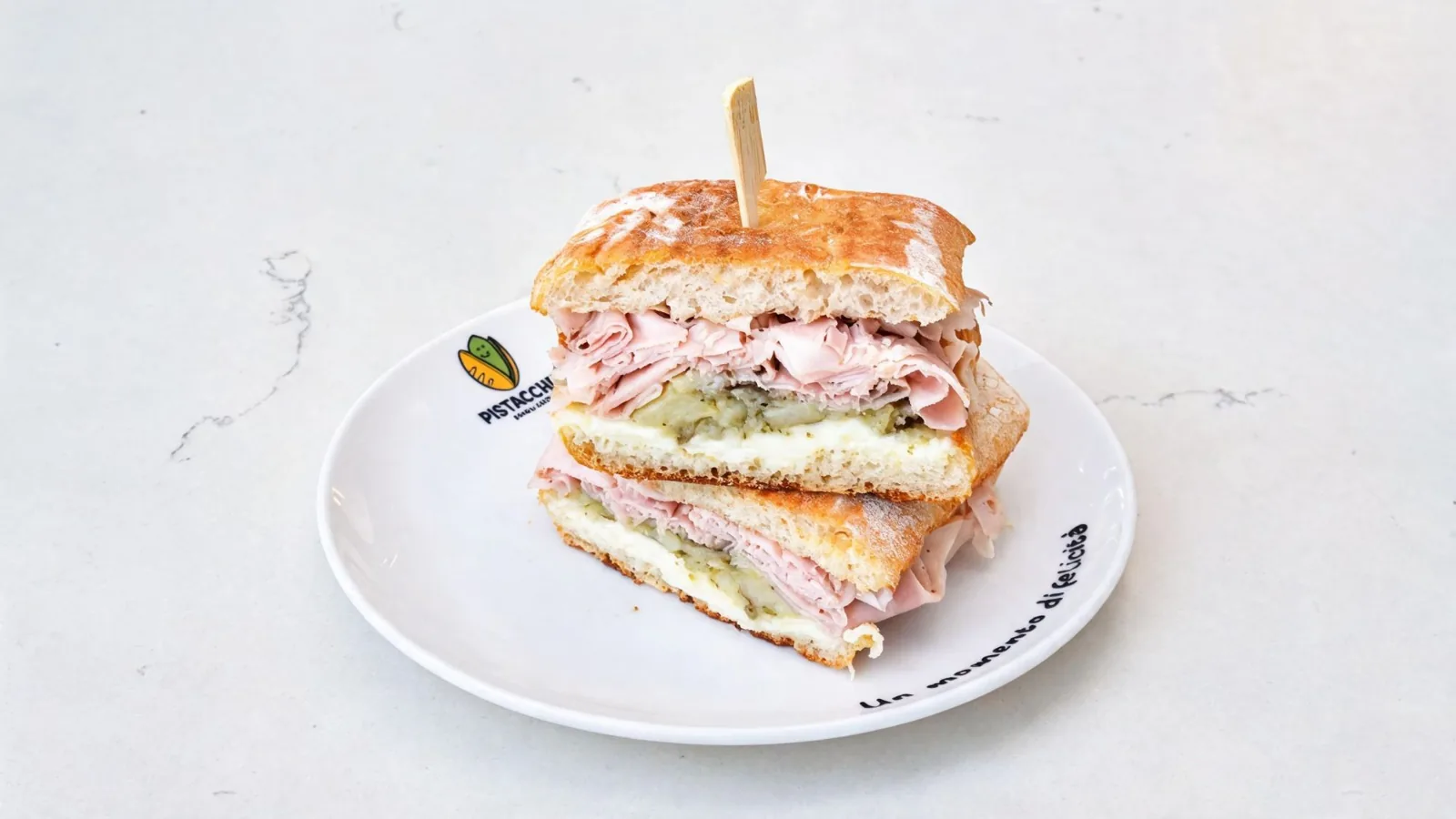
Focaccia is a soft, oily flatbread from Liguria, dimpled by fingers and baked in a pan. Ciabatta is a much younger loaf, created in the Veneto in 1982, with a wet dough, a crisp crust and big irregular holes. Schiacciata is the Tuscan name for thinner, flatter focaccia-type breads, crisper outside and chewier inside. Each one carries a sandwich differently.
Focaccia: oil pooled in the dimples
The word comes from the Latin focus, the hearth, and the Romans already had a panis focacius baked on it. The focaccia most people picture today is the Genoese one: a high-hydration dough stretched into an oiled pan, pressed all over with fingertips, then covered with olive oil, coarse salt and sometimes a little water before its last rise. The dimples, which Genoese dialect calls ombrisalli, hold the oil.
The key difference from pizza is timing. Pizza goes into the oven as soon as it is shaped; focaccia is flattened and then left to rise again, which is why it is thick and soft. In Genoa it is eaten at any hour, and at breakfast some people dip it into a cappuccino, which sounds wrong until you try it.
As sandwich bread, focaccia is soft and absorbent, which is its strength and its weakness. Toasted, it gets a crust that holds up to a creamy filling; untoasted, it can turn soggy. Ours are toasted for that reason.
Ciabatta: younger than your parents
Ciabatta looks ancient and is not. It was developed in 1982 by Arnaldo Cavallari, whose family ran a flour mill in Adria, in the Polesine area of the Veneto. The motive was commercial: Italian bakers were losing sandwich business to French baguettes, and wanted an Italian loaf to win it back. Cavallari first called it ciabatta polesana. Ciabatta means slipper, for the flat, oval shape.
The timing matters for anyone who thinks of ciabatta as rustic tradition. It was a deliberate product, designed by a miller for the sandwich market, and it succeeded because it does that one job extremely well.
The dough is very wet and made with strong flour, so it bakes into a crumb of large, uneven holes under a thin, crisp crust. That structure is what makes it good for heavy, warm fillings: the holes catch juices and melted cheese, and the crust keeps the outside from going limp. It travelled fast. Marks & Spencer brought it to British shops in 1985, a bakery in Cleveland started making it in the United States in 1987, and by 1999 the recipe had been licensed to bakers in eleven countries. Italian bakers have since made their own regional versions, so the ciabatta you buy in Rome may not look much like the original from Adria.
Schiacciata: the squashed one
Schiacciata comes from schiacciare, to flatten or squash, and in Tuscany (where it is also spelled stiacciata) it is the name for several thin, oven-baked flatbreads of the focaccia family. The everyday one, schiacciata all'olio, is bread dough with oil and salt. The dictionary lists richer relatives too: schiacciata unta, made with lard and egg yolks, and schiacciata con i siccioli, studded with crisp pork cracklings. Just to confuse visitors, Florence also has a sweet, orange-scented schiacciata alla fiorentina that is closer to a cake.
Compared with Genoese focaccia, the savory schiacciata uses less water and less oil and is baked flatter, so it comes out crisper on the outside and denser and chewier inside. That compact crumb is why Florentine sandwich shops build big sandwiches on it: it can be split and loaded without collapsing.
Pane e olio, the soft one
Not every panino needs a flatbread. In Italian bakeries pane all'olio usually means a soft loaf or roll whose dough is made with olive oil, which keeps the crumb tender. The Treccani dictionary's entry for panino mentions exactly this kind of roll, often enriched with oil, butter or milk. It is the bread for delicate fillings that would get lost in a crusty loaf.
Which bread goes under which panino
Here is how the four breads divide our sandwiches, and the reasoning behind each.
- Toasted focaccia carries the creamy and the rich. The Pistacchione loads it with mortadella and burrata under a spoon of Bronte pistachio pesto and a scatter of granella; the soft crumb takes the burrata, and the toasted crust stops it sliding.
- Ciabatta carries the heavy and warm. Il Rustico stacks roasted porchetta, smoked provola and golden potatoes, which is a lot of weight; the open crumb and crust are built for it.
- Schiacciata carries the classic fillings. Our schiacciata, with sesame on top, comes filled with cotto, caprese or tuna, the sandwich you can eat walking without losing half of it.
- Pane & olio carries the gentle. Il Classico layers cooked ham, fresh cow's milk mozzarella and sweet, chewy dried cherry tomatoes on it, flavors that a soft bread lets through.
A word on keeping them. Focaccia and schiacciata are at their peak the day they are baked, and a ciabatta's crust goes soft within hours in a plastic bag. To bring back leftover focaccia, a few minutes in a hot oven works; the microwave turns it to rubber.
All of it is baked here every morning, along with the sweet side of the counter. If you want to see what else comes out of the ovens, start at our Italian bakery page.
On our counter: Parma al Verde and our paninis. Every dish, one by one: our dishes.