Mortadella is a large cooked pork sausage from Bologna. Finely ground pork is mixed with small cubes of hard fat from the pig's throat, seasoned with salt and pepper, sometimes studded with pistachio, then cooked slowly in dry-air ovens. The traditional version is protected as Mortadella Bologna IGP. American bologna is a distant descendant named after the same city.
What the rules say goes in
Mortadella Bologna IGP is made to a written specification, and it is more exact than most people expect. The meat is pork muscle, ground very fine; the final plate it passes through has holes no wider than 0.9 millimeters, which is why the pink part is so smooth. Into that go the lardelli: cubes of fat from the pig's throat, the hardest and most prized fat on the animal. The rules require these white squares to make up at least 15 percent of the slice, evenly spread.
Salt and pepper, in grains or pieces, complete the base. The specification then allows a short list of extras: spices and aromatic herbs, natural flavorings other than smoke, sugar up to half a percent, and pistachio. Mechanically separated meat is not allowed. The production area covers eight regions of northern and central Italy, from Piedmont and Lombardy to Tuscany, the Marche and Lazio.
Cooked slowly, by the centimeter
Mortadella is not cured or air-dried like salami. It is cooked. The filled casings go into dry-air ovens until the center reaches at least 70°C, and the consortium puts the cooking time at roughly one hour for every centimeter of diameter, which for the large ones means a very long day. Afterward it is showered with cold water and rested in a cooling room until it settles.
That slow cooking is what gives mortadella its texture: compact, not springy, with a velvety cut face of even pink. The aroma is lightly spiced, and the fat softens the flavor of the meat rather than sitting on top of it.
The rules also describe what a good slice looks like, which makes a useful shopping guide. The white squares should be pearly, evenly spread and stuck firmly to the meat; there should be no pockets of fat or jelly, and only a thin film of fat around the edge. On its own, the word mortadella on a label guarantees none of this. Look for Mortadella Bologna IGP if you want the protected recipe.
Why some mortadella has pistachio
Pistachio is optional. It appears in the official list of permitted ingredients, so a mortadella can carry the IGP name with or without it. There is no documented origin story for why pistachio got onto that list, and you should be wary of anyone who offers one with a date attached. What is easy to see is why it stuck: the nut adds a little crunch, a faint sweetness and a flash of green against the pink and white, and it echoes the fat's richness without adding more of it.
Two stories behind the name
The consortium gives both. One traces the word to the Latin mortarium, a mortar, since the meat was once pounded by hand. The other points to myrtatum, from myrtle, the flavoring of an ancient sausage that Pliny the Elder and Varro both mention. Neither has won.
The consortium traces the tradition back a long way: a Roman stele in Bologna's archaeological museum shows seven piglets beside a mortar and pestle, and in the seventeenth century the writer Vincenzo Tanara described the recipe in detail. The consortium also celebrates 24 October 1661, when Cardinal Farnese issued a decree in Bologna setting out how mortadella had to be made. It calls the date legendary itself, and it is now marked as International Mortadella Day.
The modern story is more industrial. From the nineteenth century, the first semi-industrial pork processors around Bologna carried mortadella onto markets across Italy and abroad, and production spread from the city into neighboring regions, which is why the protected area today is so much larger than Bologna itself.
Mortadella vs bologna
American bologna takes its name from the city, and it descends from mortadella, but only loosely. Most commercial bologna is smooth all the way through, without the visible cubes of fat that the Italian rules require, and the route it took to American lunchboxes is not well documented. Some food writers credit German immigrants with bringing the sausage style; Italian immigrants brought mortadella separately. Think of them as relatives who no longer recognize each other.
How to slice it, and where we use it
Mortadella is sliced thin, on a machine, in steady strokes, so each slice comes off whole. In Italy it also turns up in cubes about a centimeter on each side for the aperitivo table, or in wedges cut from a thick round. Slices should be laid out flat rather than stacked hard, or they crush. Among the consortium's own recipes is a pink mousse: mortadella blended with ricotta and whipped cream, chilled, and spread on toasted bread as crostini.
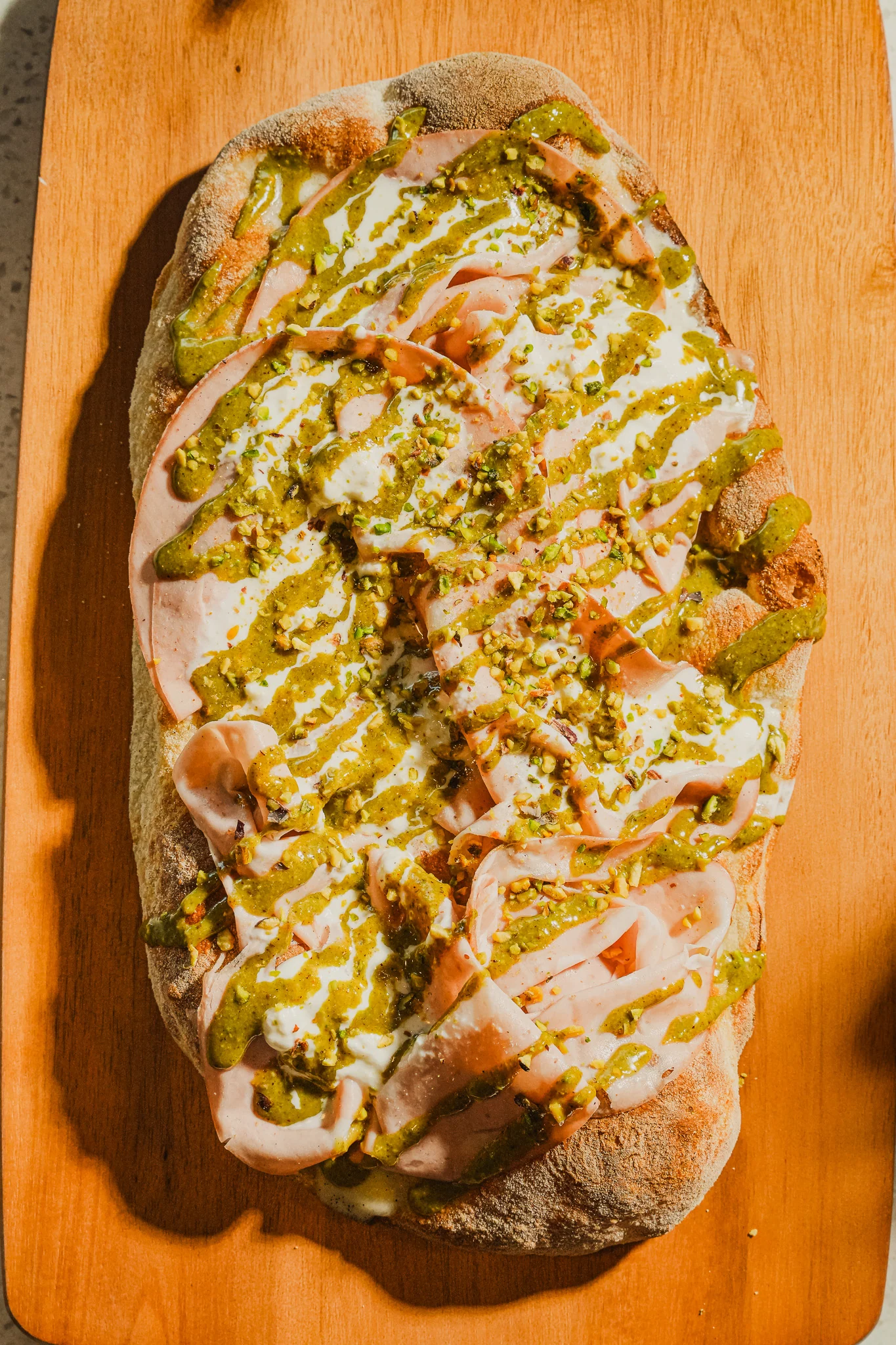
At our counter it goes into two things. The Pistacchione, our mortadella and burrata panino on toasted focaccia, with Bronte pistachio pesto and pistachio crumble on top, built around exactly that pink, white and green. And the Pinsa Pistacchiona, the Roman-style pinsa we make for two, where mortadella shares the top with pistachio pesto, crumbled pistachio and a fresh cheese. The cheese question has its own explanation in burrata, mozzarella and fior di latte compared.
On our counter: our paninis. Every dish, one by one: our dishes.