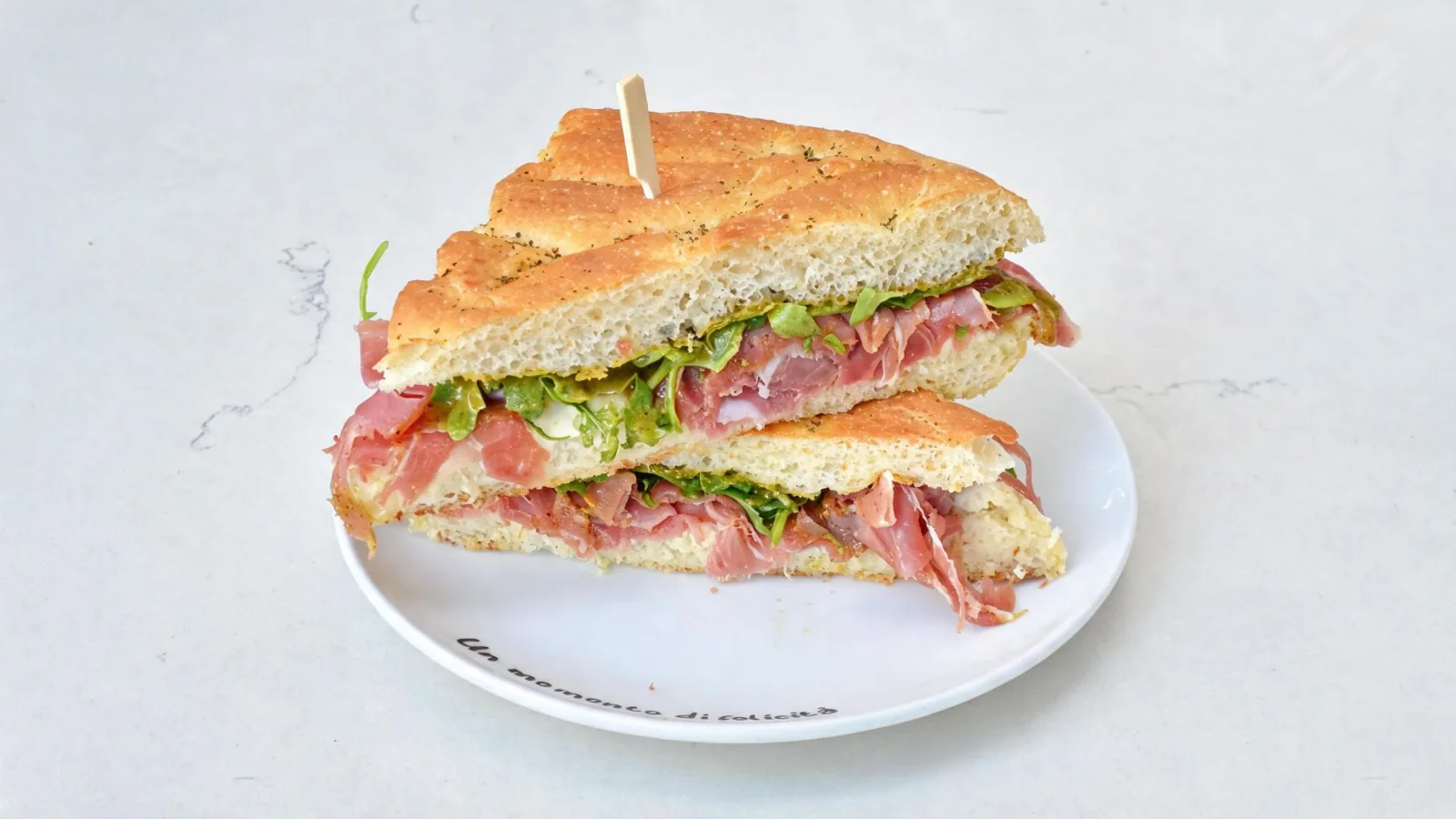
Prosciutto di Parma is prosciutto crudo: a pork leg salted with sea salt and air-cured for at least 14 months, never cooked. Prosciutto cotto is cooked ham, brined and cooked in a mold. Because prosciutto alone simply means ham in Italian, at a deli counter in Italy you ask for crudo or cotto.
One word, two very different hams
In the United States, “prosciutto” on a menu almost always means the cured, translucent, rose-colored kind. In Italy the word on its own is incomplete. It means ham, and the adjective does the work: crudo, raw, for the cured leg; cotto, cooked, for the pink sandwich ham. Ask for prosciutto at an Italian deli counter without either word and the person behind the slicer will ask which one you mean.
Parma is one crudo among many. Italy has a number of protected cured hams, of which Prosciutto di San Daniele, from Friuli, is the other name most Americans see; each has its own rules and its own taste. Prosciutto di Parma is the one branded with the ducal crown.
The two share an animal and a cut, the hind leg of the pig, and very little else. One is a product of salt, air and months of waiting. The other is a product of the kitchen.
Crudo: how Prosciutto di Parma is made
Prosciutto di Parma is a protected designation of origin, and its specification is strict. The pigs must be born, raised and slaughtered in eleven listed Italian regions. The hams are then cured in a small, defined part of the province of Parma: at least five kilometers south of the Via Emilia, up to 900 meters of altitude, between the Enza and Stirone rivers, where the air off the hills does much of the drying.
Salting is done exclusively with sea salt, wet on the rind and dry on the lean parts. The specification is explicit that no chemicals, preservatives or other additives are used, and the hams are not smoked. Then comes time: a minimum of 14 months of aging, including the month the seal goes on at salting. Only hams that pass inspection get the fire-branded ducal crown, and without the crown the name cannot be used. A finished leg must weigh between 8.2 and 12.5 kilograms, and inspectors check samples for salt, moisture and the breakdown of proteins that comes with good aging. The finished ham is meant to taste delicate and mild, not particularly salty, with fat that is pure white against the pink.
Cotto: the cooked one
Prosciutto cotto is also defined in Italian law. It is made from the pig's leg, which may be boned, trimmed of fat, tendons and rind, then injected with a brine of water, salt and curing salts, massaged so the brine spreads, pressed into a mold and cooked. Some is pasteurized afterward to keep longer.
Here is one of the sharpest differences between the two hams. Parma's specification excludes preservatives altogether and relies on salt, air and time; cotto, which is moist and cooked, depends on curing salts to keep it safe and pink. Neither is better. They are built for different jobs.
The rules sort it into grades. In the higher ones, alta qualità and scelto, you should be able to see at least three of the four main muscles of the leg in the middle of a slice, a sign that it was made from a whole leg rather than pieces pressed together. Good cotto tastes gently sweet and of pork, and its texture is soft and moist where crudo is silky and dense.
How to ask for each in Italy
At a salumeria you order by the etto, a hundred grams. Un etto di crudo gets you thin slices of cured ham; un etto di cotto, cooked ham. If you want a specific crudo, name it: crudo di Parma. Crudo is sliced thin enough to see through; cotto can be a little thicker without suffering.
Crudo tastes fullest at room temperature, sliced just before it is eaten; straight from the fridge the fat tastes of very little. In summer Italians pair it with melon or figs, salt against sweet, and in a sandwich it wants the same kind of contrast.
In sandwiches, the two do different jobs. Crudo is salty and savory and likes company that is fresh or creamy: soft cheese, greens, something green and nutty. Cotto is mild and takes heat well, which is why it so often ends up inside baked things and melted-cheese sandwiches.
Which ham goes in which sandwich here
Our counter uses both, and the split follows those habits.
- Crudo: Parma al Verde lays Prosciutto di Parma on toasted focaccia, then adds fior di latte, a handful of rucola and our homemade Bronte pistachio pesto. The cured ham brings the salt; everything around it is fresh and soft.
- Cotto, cold and simple: Il Classico, with prosciutto cotto on pane & olio, keeps the ham company with fior di latte and pomodorini secchi, the dry-aged cherry tomatoes.
- Cotto in a croissant: Il Tricolore pairs prosciutto cotto and fior di latte mozzarella inside a croissant.
- Cotto, baked in: our parigina, the Neapolitan layered pastry sold by the slice, has prosciutto cotto, melted mozzarella and San Marzano tomatoes inside.
If you are standing at the counter and cannot decide, the question to ask yourself is the Italian one: crudo or cotto?
On our counter: our paninis. Every dish, one by one: our dishes.