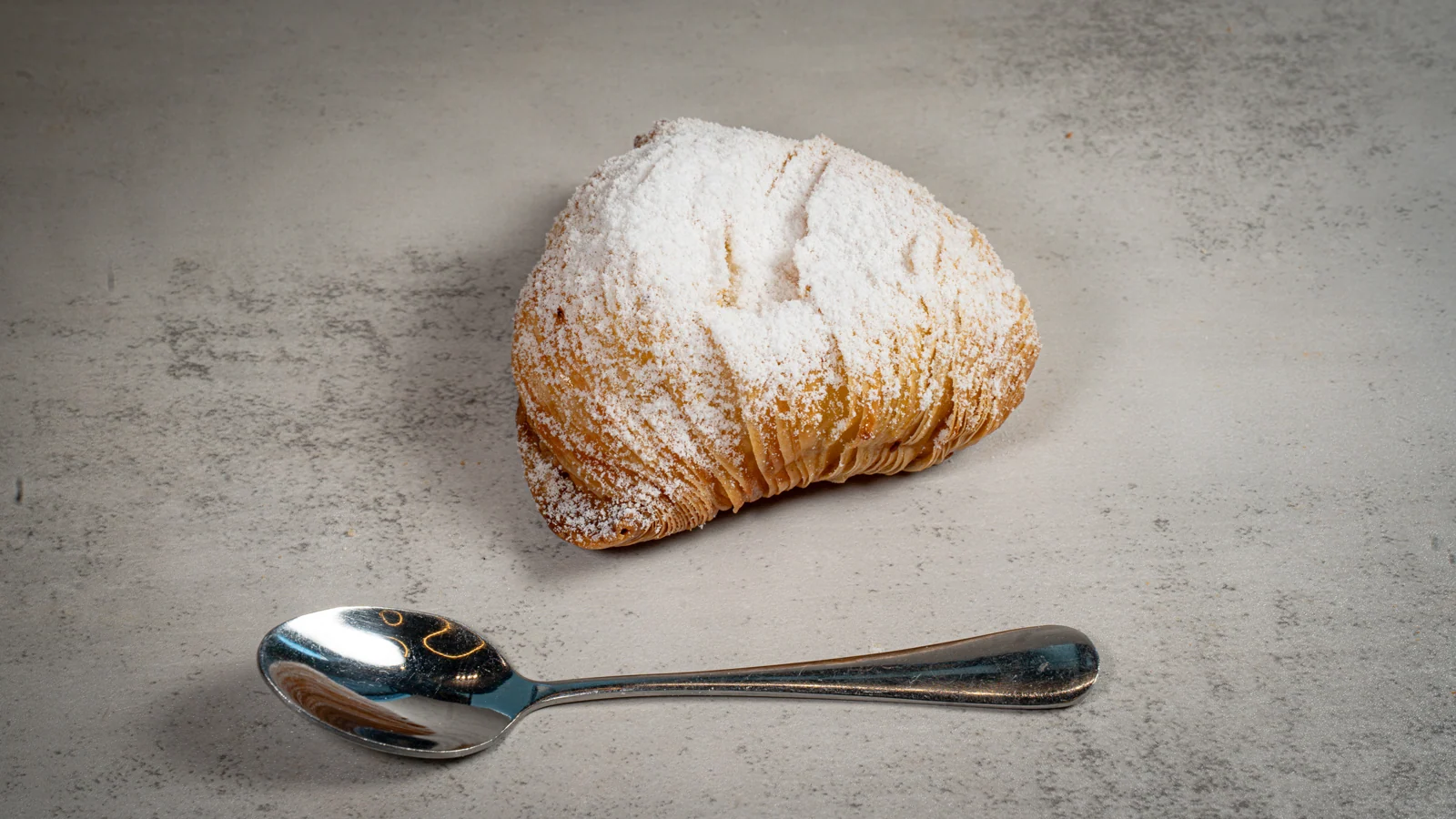
An Italian pastry case is not a menu, it is a map. Most of what is behind the glass falls into four families: laminated pastries, filled brioche, shortcrust cakes and fried dough. Once you know which family you are looking at, choosing takes five seconds.
Start here: the sfogliatella
If you only try one thing, this. The sfogliatella riccia — "curly" sfogliatella — is the emblem of Naples: a shell-shaped pastry built from dough stretched almost to transparency, rolled into a log, sliced and pushed outward into ridged leaves. Baked, those leaves separate into dozens of shattering blades. Inside is semolina cooked in milk, ricotta, sugar and candied citrus peel.
It dates to the seventeenth century and, by the usual account, to the convent of Santa Rosa on the Amalfi Coast, where nuns are said to have invented it from leftovers. It is difficult to make and almost impossible to make quickly, which is why plenty of bakeries that sell everything else do not sell this.
Eat it warm, on the day, with an espresso. The citrus in the filling and the bitterness of the coffee are built for each other.
The laminated family: cornetti and croissants
These are the morning pastries, and the distinction between them is real: a croissant is French, lean and crisp; a cornetto is Italian, sweeter, enriched with egg and sugar, and made to be filled. We went through the whole difference in a cornetto is not a croissant.
On the counter: croissants plain, almond ($6.50), chocolate ($6.30), pistachio ($6.80), and — a concession to the city we are in — guava and cream cheese ($6). Cornetti filled with pistachio ($6.80) or with cream and amarena cherry ($6.50). And two pani, which are the rectangular ones: pain au chocolat ($6.30) and a pistachio and chocolate version ($6.80).
The brioche family: soft, sweet, filled
Brioche dough in Italy is not the French loaf. It is enriched, faintly citrus- scented and used as a vehicle.
The veneziana ($6.80) is a round, sugar-crusted brioche split and filled — ours with pistachio cream. It is the single best argument for the whole pistachio project, because there is enough filling in it that nothing can hide.
The brioche col gelato is Sicilian breakfast, taken literally: a brioche bun filled with gelato and eaten in the morning without embarrassment. If that seems excessive, consider that Sicily is hot and Miami is hotter.
The shortcrust family: pasticciotto and the biscotti
The pasticciotto ($6.30) comes from Puglia: a small oval of buttery shortcrust filled with pastry cream, baked until the shell is sandy and the centre still trembles. Ours carries amarena cherry alongside the cream.
Then the occhio di bue — "ox eye" — the round shortbread with a window cut in the top so the filling shows through. Apricot ($5), chocolate ($5), pistachio ($5). And the biscotto amarena e cioccolato ($6), which is the one to buy if you want something that survives the drive home.
The fried family: zeppola
The zeppola ($8) is choux pastry, fried rather than baked, piped with cream and finished with an amarena cherry. In Naples it belongs to Saint Joseph's Day in March — zeppola di San Giuseppe — but the association has loosened everywhere, ours included.
It is the most fragile thing in the case. Eat it the same day or do not bother.
The desserts, which are a different decision
Tiramisù is not pastry, it is dessert, and it changes the shape of a visit: you sit down for it. Classic ($10), or the pistachio version ($12). There is also a pistachio cake, a cup of gelato, and a tray of pasticceria mignon — the assortment of miniatures that Italians buy by weight on a Sunday and carry to someone else's house.
What to take home, and how not to ruin it
Almost everything in an Italian pastry case is built to be eaten the day it is made, and the failures are predictable.
Never the refrigerator. This is the single most common mistake. Cold air stales starch faster than room temperature does — a croissant left in the fridge overnight is measurably worse than one left on the counter. The exception is anything containing fresh cream or ricotta, which has to be refrigerated for safety, and which you should therefore simply eat sooner.
Laminated pastry: same day, ideally within a few hours. If it has gone soft, three or four minutes in a hot oven — not a microwave — brings most of the crispness back. A microwave turns butter layers into steam and you get a chewy, sad object.
Shortcrust: two or three days in a tin at room temperature, and it is arguably better on day two once the filling has settled into the biscuit.
Fried: the same day. There is no rescue and no reheating.
Whole cakes: keep them cold, then take them out a good half hour before serving. Fat carries flavour and cold fat carries almost none, which is why a cake straight from the fridge tastes of very little.
How to actually order
Three rules, and then stop overthinking it.
- Morning is laminated. Cornetto or croissant, with coffee, standing up. Under ten minutes.
- Afternoon is shortcrust. Biscotti and pasticciotto keep their texture through the day; laminated pastry does not.
- Ask what came out last. This is the only genuinely useful question at any bakery counter, and the answer changes hourly.
The full case, with prices, is on the menu, and there is more on the sweet side of the shop on the pastry page. If you are taking a tray to an office or a party, the catering arithmetic is here.