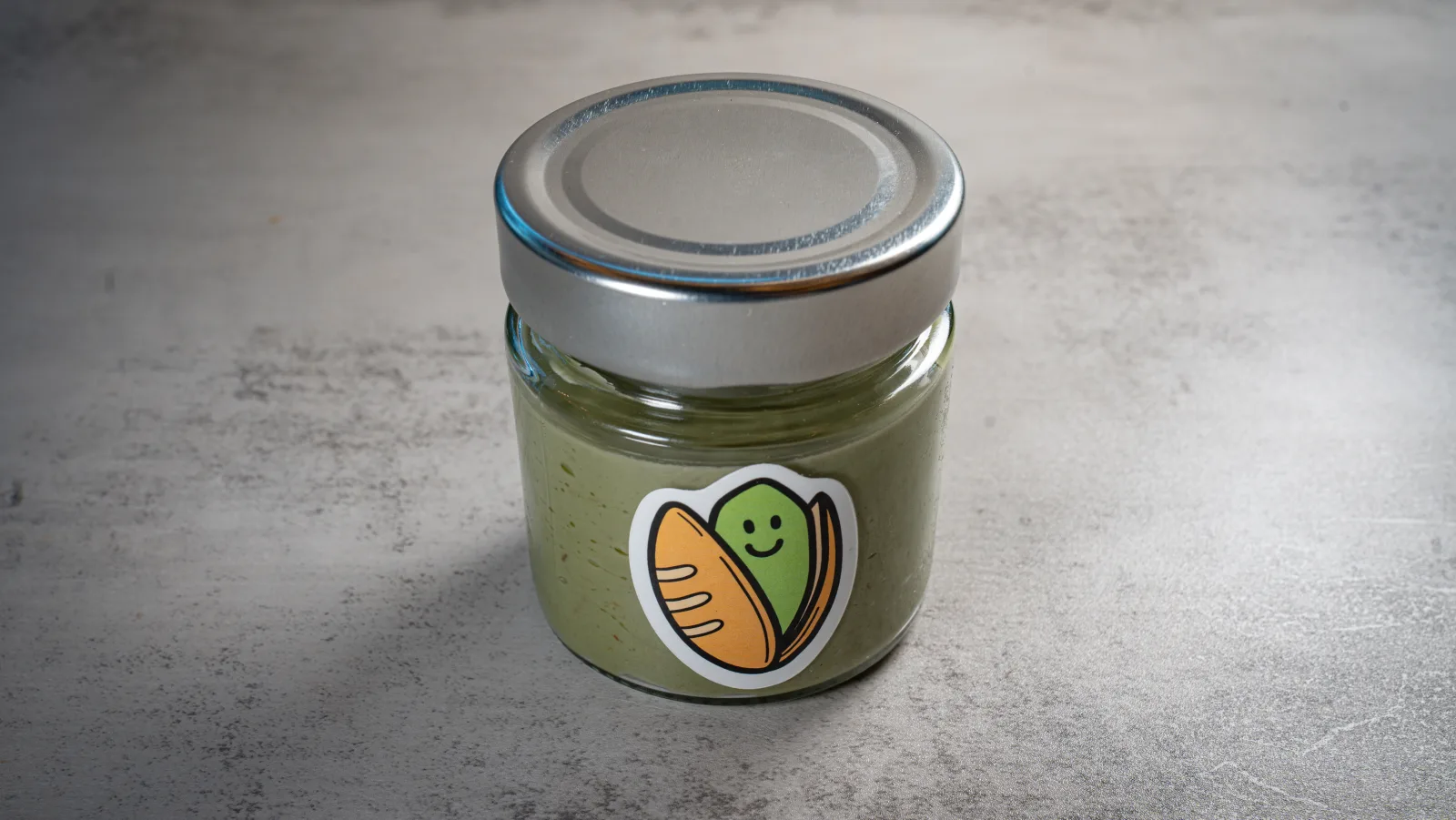
Real pistachio cream is made of ground pistachios, sugar, and very little else. It is the colour of dried sage — muted, a little brown at the edges, never mint. If a pistachio filling is brilliantly green, that colour came from somewhere other than a pistachio.
The year everything turned green
A chocolate bar filled with pistachio cream and shredded kataifi pastry went around the world on a phone screen, and the pistachio stopped being a nut and became a colour. Within two years it was in everything: lattes, cheesecakes, croissants, ice cream, tiramisù, spreads sold by the jar.
Demand for pistachio paste rose faster than pistachios could be grown. A pistachio tree does not care that it is trending. It takes about twelve years to bear its first serious crop, and the best of them fruit only every other year. So the paste did not multiply. The colour multiplied.
This is not an accusation aimed at anyone in particular. It is simply what happens to any ingredient that becomes fashionable faster than it can be farmed. It happened to vanilla. It happened to truffle. The useful response is not outrage — it is knowing how to look.
Where the real one grows
Bronte is a town on the western slope of Mount Etna, in Sicily. The trees there are not planted in soil so much as wedged into old lava, on ground that tilts too steeply for a machine to climb. Everything is picked by hand.
Three things make that fruit different. The volcanic mineral profile of Etna, which gives the nut its perfume and its deep green. The biennial harvest — the trees are pruned so they fruit every second year, which halves the yield and concentrates what is left. And the altitude, which slows everything down.
The result carries a protected name: Pistacchio Verde di Bronte DOP. Denominazione di Origine Protetta — only nuts grown on that ground may use it. Pistachio cultivation there goes back to the Arab rule of Sicily in the ninth century, which means the practice is roughly eleven hundred years old and has never been industrialised.
Bronte's entire annual crop is a rounding error beside the world's commodity pistachio harvest. That, more than anything, is the price.
Why it costs what it costs
Stack the reasons and the number stops being mysterious. Half the harvest years. Hand-picking on volcanic slope. Hand-shelling, because the kernel is long and thin and machines break it. Certification. A crop small enough that it is sold, in practice, to people who already know what they are buying.
A kilo of Bronte paste costs a large multiple of a kilo of generic pistachio paste — and generic pistachio paste itself costs a large multiple of the pastel-green "pistachio" filling whose first ingredient is sugar and whose second is vegetable oil. Those three things all get called pistachio cream on a menu. Only one of them is mostly pistachio.
Four ways to tell, standing at the counter
1. The colour
This is the fastest tell and the most reliable. Ground pistachio is a dull, slightly olive green that browns where it meets air, and it is never perfectly even. Fluorescent, uniform, birthday-cake green is a dye. Spirulina and chlorophyll are used too, and they are food-safe — they are just not pistachio.
2. The grain
Real ground pistachio is not silk. Tilt the spoon and you should see flecks: fragments of kernel, some paler, some darker, and a slick of oil that separates if the jar sits still. A filling that is glossy, homogeneous and pipes like toothpaste has been emulsified into submission, usually because there is not enough nut in it to hold together on its own.
3. The smell
Put it under your nose before you taste it. Pistachio smells faint, green and buttery — you have to go looking for it. Flavouring announces itself: sharper, sweeter, with a marzipan edge that reads more of almond than of pistachio. If the aroma arrives before the spoon does, it was engineered to.
4. The order of the ingredients
On a jar, ingredients are listed by weight. Read the first two. If sugar, glucose syrup or sunflower oil come before the nut, you are buying sweetened fat with a suggestion of pistachio in it. Good paste lists pistachios first, and frequently lists almost nothing after.
What happens here at four in the morning
We grind ours. That is the whole of the strategy, and it is also the reason the kitchen light goes on at four: the paste is made, the dough that fermented overnight is folded, and the ovens are loaded so that the bread is still warm when the doors open at eight.
You can taste the argument most directly in a few places on the menu: the Croissant al Pistacchio ($6.80), the Veneziana al Pistacchio ($6.80) — a brioche filled rather than merely striped — the Tiramisù al Pistacchio ($12), and, if you want it savoury, the Pinsa Pistacchiona ($16) or the Pistacchione panini ($16).
Order any of them and look at the colour before you eat. That is the entire test, and it works on us as well as on everyone else.