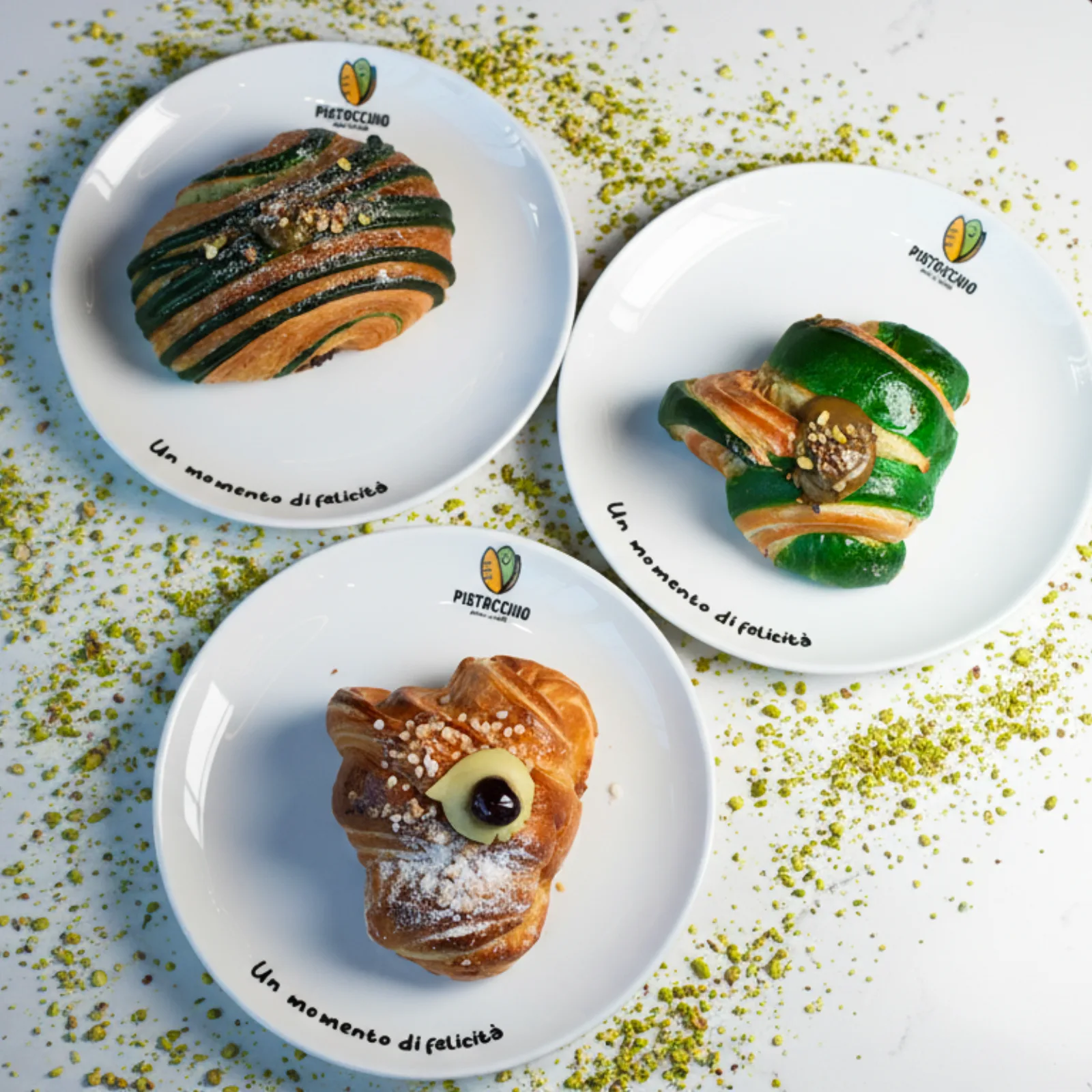
A croissant is a French pastry of laminated butter dough: lean, flaky, shatteringly crisp. A cornetto is Italian: softer, sweeter, enriched with egg and sugar, closer in character to a brioche — and built to be filled. Same crescent, different animal.
Start with the dough, because everything follows from it
A croissant is lean. Flour, water, salt, yeast, and then a great deal of butter folded in as a separate sheet. The dough itself is not sweet and not enriched; it is a vehicle for lamination. Roll, fold, chill, repeat, and each turn multiplies the layers of dough and fat until they are counted in the hundreds. In the oven the water in the butter turns to steam and pushes those layers apart. That is the whole trick, and it is why a good croissant makes a mess when you bite it.
A cornetto starts somewhere else. The dough is enriched from the beginning — sugar, egg, sometimes honey, often citrus zest, and a fat that may be butter but historically was lard or oil. It is laminated too, but less aggressively, and the sweetened, egg-rich dough behaves differently under heat. It puffs rather than shatters. The crumb that results is softer, a little bready, and closer to brioche than to pastry.
Which is why one gets filled and the other does not
This is the part people notice without knowing why. In France you will not usually find a croissant injected with cream — if you want chocolate in a French pastry you order a pain au chocolat, which is a different shape entirely. Filling a croissant would be working against it: the whole structure is engineered to be dry, crisp and hollow, and cream turns that into a damp sponge.
The cornetto has the opposite problem to solve. A softer, sweeter, more absorbent crumb wants something to carry. So Italy fills them, as a rule and not as an exception: pastry cream, apricot jam, chocolate, lemon cream, amarena cherry, and — where we come from — pistachio.
The French built a pastry that is perfect empty. The Italians built one that is only finished once you put something inside it.
And why a cornetto is sweeter before you add anything
Because sugar is in the dough, not only on it. A croissant gets its sweetness almost entirely from the caramelisation of its own crust and whatever it is served with. A cornetto arrives sweet. That matters for what you drink alongside it: the bitterness of an espresso is not decoration, it is the counterweight.
They are, in fact, cousins
Both descend from the same ancestor: the Austrian kipferl, a crescent-shaped roll documented in Vienna centuries before either of its famous descendants existed. It was denser than either, closer to a sweet bread roll, and it was not laminated at all.
You will be told that the crescent commemorates the defeat of the Ottoman siege of Vienna in 1683 — bakers working through the night heard the tunnelling, raised the alarm, and baked the enemy's own crescent to be eaten. It is a wonderful story and food historians consider it almost certainly invented after the fact. The same goes for the claim that Marie Antoinette carried the kipferl to France; the earliest solid French references to the croissant come much later, in the nineteenth century.
What is not in dispute is what each country did with it. France laminated it, turning a bread roll into a pastry. Italy enriched it, turning a bread roll into something closer to a sweet brioche, and then filled it. Two nations were handed the same crescent and made opposite decisions about what to do with the fat and the sugar. Both were right.
The Italian breakfast, which is smaller than you expect
An Italian breakfast is a cornetto and a coffee, standing up, in about seven minutes. There is no plate of eggs, no side of fruit, no negotiation. It is not an austerity measure — it is a rhythm. Sweet pastry, bitter coffee, out the door.
It also has rules, and the firmest one is about milk. Cappuccino belongs to the morning; ordering one after lunch marks you out immediately. If you want the whole etiquette, we wrote it down in how to order coffee like a Neapolitan.
What that means at four in the morning
Lamination is not a step you can rush, and it is not a step you can do at nine. The dough ferments overnight — slowly, cold, which is what develops the flavour that fast yeast never produces. It is folded by hand in the small hours, because butter and warm hands are enemies and the kitchen is coldest then. Sixty-four layers go into each cornetto. By eight, when the doors open, they are still warm, and warm is a state that lasts about two hours and cannot be faked later.
On the bakery counter you will find both traditions, because both are worth having. Croissants — plain, almond ($6.50), chocolate ($6.30), guava and cream cheese ($6), pistachio ($6.80). And cornetti, which is where the fillings live: pistachio ($6.80), cream and amarena cherry ($6.50).
If you have never eaten them side by side, do that once. Order one of each and a plain espresso. The difference stops being a technicality within about four seconds.